ATTENTION: Professionals & Business Owners With $500k+ Investable Assets Under Management
Your Advisor Manages 300 Other Families, Where Does That Leave You?
Uncover the truth behind financial management, and find the real gaps in your portfolio, without having to consult 5 different professionals.
What's Inside?
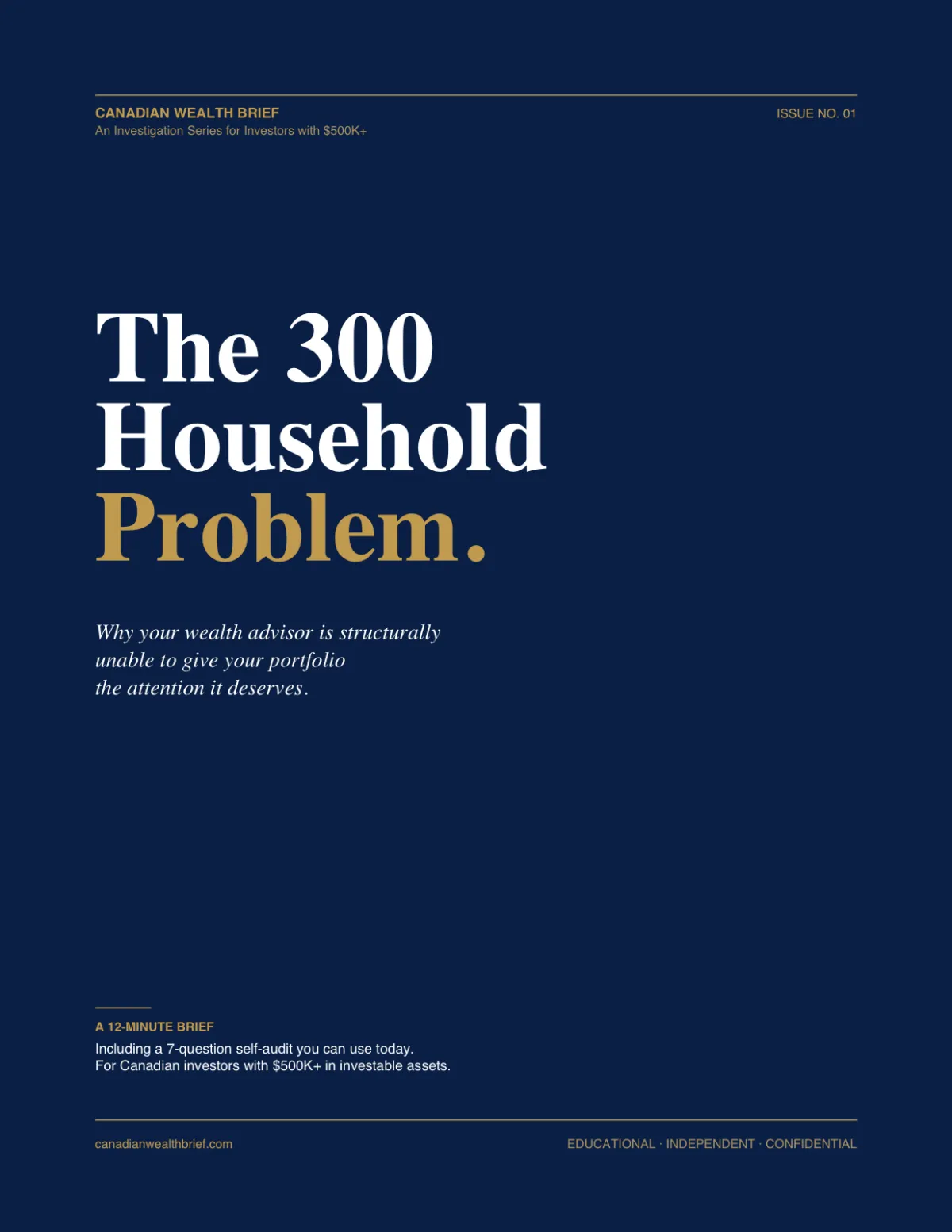
01 — The 300 Household Problem. Why most advisors can't deliver the service their fees imply.
02 — The Math of Inattention. What a 1.25% fee actually costs over 30 years.
03 — The Approval Delay. Why the recommend-and-approve model loses you money in fast markets.
04 — The 7-Question Self-Audit. Print this. Use it in your next advisor conversation.
05 — What to Look For. The six standards every wealth manager should meet.
There's a structural problem at the heart of Canadian wealth management. Most investors only notice it when something goes wrong. Spot The Difference Today By filling in the survey
The question you should have already asked your advisor
Call your current advisor this week and ask them one thing: How many client households do you manage?
If the answer is over 100, you have a problem. Most bank-based advisors in Canada are managing 250–300 families at once. Some are higher than that.
That's not a criticism of the individual advisors. They're working within a system designed to maximize revenue per advisor, not service per client. But the result for you is the same either way.
"91% of advisors said serving too many non-ideal clients was a moderate or major challenge."
— Cerulli Associates, Industry Research
At 300 households, here's what a good advisor's day actually looks like. They have roughly 250 working days a year. Even four real conversations per client — a conservative number for proper planning — is 1,200 touchpoints. That's five per day, every day, before research, internal meetings, compliance, or actual portfolio management.
It doesn't add up. And you feel it. The annual review that feels rushed. The voicemail that takes two days to return. The "stay the course" email when the market drops 30%.
That email wasn't a strategy. It was the only thing an overextended advisor could send 300 families in a day.
"The general feedback is that advisors are often slow to respond and the advice is not personalized."
— Long Angle Survey of High-Net-Worth Investors (CNBC, 2025)
The quiet cost of average service
Standard wealth management fees run 1–1.25% annually. That number sounds modest. Over time, it's not.
Starting portfolio
$1,000,000
30-year growth at 7% (no fees)
~$7,600,000
30-year growth at 5.75% (after 1.25% fee)
~$5,300,000
Difference
~$2,300,000
That $2.3 million gap isn't just the fee. It's everything the fee represents: advice that isn't personalized, tax strategies that aren't implemented, moves that can't be made quickly because 300 other calls are waiting.
The fee is fine if you're getting real value. Most people aren't sure whether they are.
On tax planning: High net worth investors often have concentrated gains in portfolios, secondary properties, or businesses. Strategies around the timing of dispositions, corporate structures, and estate planning can have significant dollar impact — but they require someone with the time and mandate to look closely at your specific situation. If your advisor is managing 300 families, that time is hard to find.
Advisory Model vs. Discretionary Management
Most investors don't know there are two fundamentally different ways an advisor can work. The difference matters most when markets move fast.
Advisory Model (Most Advisors)
Recommends changes, requires your approval before acting
Market drops on Tuesday. You're in a meeting. They leave voicemail. Trade happens Wednesday — after another 3% drop
300+ client households means reactive, not proactive
Service scales to whoever is loudest, not who has the most at stake
Tax planning is generic — no time for specific structures
Discretionary Management
Acts within agreed parameters without waiting for approval each time
Market drops on Tuesday. Portfolios are repositioned the same morning. You get a summary explaining exactly what was done and why
Limited client roster means attention is allocated, not rationed
Proactive contact when something relevant changes — not just annual reviews
Tax structures reviewed individually with CPA, CA and estate specialists on the team
Discretionary portfolio management requires a specific credential in Canada — the Chartered Investment Manager (CIM) designation. It also requires a different kind of practice: fewer clients, deeper work, real accountability for outcomes.
The team behind this advisory also includes a Senior Planning Specialist, an Estate and Trust Specialist with significant experience in estate law, and an Insurance Specialist.
For clients with ultra high net worth — or complex situations involving companies, holdcos, or trust accounts — they'll bring in lawyers, accountants, and when relevant, business valuators and M&A specialists.
The Strategic Wealth Assessment
This is a diagnostic conversation, not a sales pitch. At the end, you'll know exactly where you stand — and whether anything needs to change.
Fee Analysis
What you're actually paying — not just the stated management fee, but underlying fund costs and embedded charges — translated into long-term dollar impact.
Tax Exposure Review
Where your unrealized gains are concentrated and what planning options exist — across your portfolio, corporate structures, and real estate holdings.
Portfolio Structure Check
Are the right assets in the right accounts? RRSP, TFSA, non-registered, corporate — reviewed for tax efficiency.
Service Model Fit
Is the level of service you're currently receiving appropriate for your wealth and the actual complexity of your situation?
Active Risk Analysis
Are you getting exposure to the top regions and sectors? Or are you overexposed anywhere with added risk?
Conflict of Interest Review
Are you holding onto poor performing products when there are better alternatives? Are you in proprietary investments offered directly from your advisors company?
If your current situation is working well, we'll say so. You walk away with clarity and nothing has to change. If there are gaps, we'll show you specifically what they are.
Common questions
Is this actually free?
Yes. There's no charge for the assessment and no obligation to do anything after. If you decide the conversation was worth an hour of your time, that's the whole point.
What if I'm already happy with my current advisor?
Then this will confirm it. Most people haven't done a proper fee analysis or stress-tested their tax exposure since the capital gains changes. Even if nothing changes, the clarity is worth having.
I have most of my wealth in real estate, not investments. Is this still relevant?
Probably yes. Many Vancouver families have significant unrealized gains in secondary properties, rental real estate, or businesses — all of which are subject to the new capital gains rules. This is one of the more common and overlooked exposures we see.
Do I have to move my accounts to benefit from this?
No. The assessment is informational. If there's a case for working together, we'll explain it clearly. If not, you'll still walk away with a better picture of your situation.
Request your Strategic Wealth Assessment
Takes about two minutes. We'll reach out to confirm a time that works.
CFA Charterholder
Chartered Financial Analyst
CIM Charterholder
Discretionary Portfolio Management
Tax & Estate Specialists
Dedicated planning team
Insurance Specialists
Tax-exempt wealth strategies
This page is for informational purposes only and does not constitute investment advice. Fee and return illustrations are hypothetical examples only. Past performance is not indicative of future results.